Class V and fibre-post materials: build distinct supply lists
In many clinics, Class V restorative materials and fibre-post materials end up on the same shelf. Both involve adhesives and resin products, so a shared storage zone feels natural. That shared location quietly hides two different sets of purchase requirements. A restorative composite, a post cement and a core build-up material each need their own identity and their own compatible accessories. A broad request for “bonding materials” does not define a complete order, and it gives the supplier too much room to guess.
The fix starts upstream. Create separate clinician-approved preparation lists for the two workflows. The clinical team decides which materials and objects belong on each list. Purchasing then translates those decisions into exact products, formats, companion items and acceptance checks. The aim is simple: keep the correct supplies available, without turning a procurement article into guidance on lesions, post placement or treatment selection.
Composite categories need exact product names
Flowable and paste composites create different inventory entries, and within a flowable family, handling variants need separate identification too. Keep the manufacturer’s full product name, shade and delivery format on the order. Do not reduce them to “flowable A shade,” and never substitute by syringe colour alone.
Shofu Beautifil Flow Plus and Beautifil Flow Plus X are distinct named products. Their F00 and F03 variants — F00 being the absolutely stable, shape-retaining version and F03 the self-levelling, moderately flowable one — need to remain attached to the full product identity. Preserve the approved generation and variant on every order line. A quote that quietly changes Flow Plus to Flow Plus X is a product change requiring review, even when the handling label looks familiar.
Product-level documentation matters more than blanket statements about flowable composites. GC G-ænial Universal Injectable is another identifiable restorative product with its own handling and use information. Procurement should obtain the exact approved item and its documentation. A general comparison of flowable versus paste materials is neither a purchasing ban nor a claim of universal equivalence.
Adhesive and finishing supplies belong in the restorative list
An approved adhesive system adds applicators, dispensing supplies and any required companion products. Identify those objects separately. If the clinic uses a bottle in one workflow and unit doses in another, preserve both formats in the stock record. Consumption and replenishment then stay visible, without assistants calculating equivalents from memory.
Finishing supplies need the same discipline. A disc system, interproximal strip, rotary polisher and paste have separate forms and interfaces. Record the approved product and the matching mandrel or application tool. A material list ending with “polishers” fails to identify what the assistant must actually retrieve.
Keep a labelled tray map linking the approved preparation list to real stock. Update it when a product presentation changes or a new refill arrives. A photograph helps with organisation only when its objects are named. Never treat an old preparation photograph as authority to substitute the nearest item in the drawer.
A fibre post is more than a diameter
The fibre-post order should name the manufacturer, system, post reference and supplied dimensions. The clinician selects the approved post; purchasing preserves that identity and obtains the matching accessories. “Glass fibre post” describes a broad category and leaves the post’s commercial reference unresolved.
Material construction should be taken from the exact product’s documentation. Glass fibres in a resin matrix is a meaningful component description, but it proves nothing about a particular surface treatment or cement compatibility. Ask for the current instructions for the post being supplied, and do not transfer a treatment instruction from a different post or a broad material category.
Matching drills need their own references as well. A post assortment does not necessarily identify every companion drill, and a drill with a similar colour is not a confirmed match. List the approved post–drill relationship explicitly. That gives the receiver a concrete check and gives the stock controller an accurate replacement line.
Separate post cement from core material
A cement approved for post cementation and a composite intended for direct restorative use are different purchase objects. Keep the cement identity, cure mode and delivery format visible. Ask the clinical team to approve the complete adhesive-and-cement combination before releasing the order. Do not ask a supplier to infer it from the phrase “dual-cure bonding kit.”
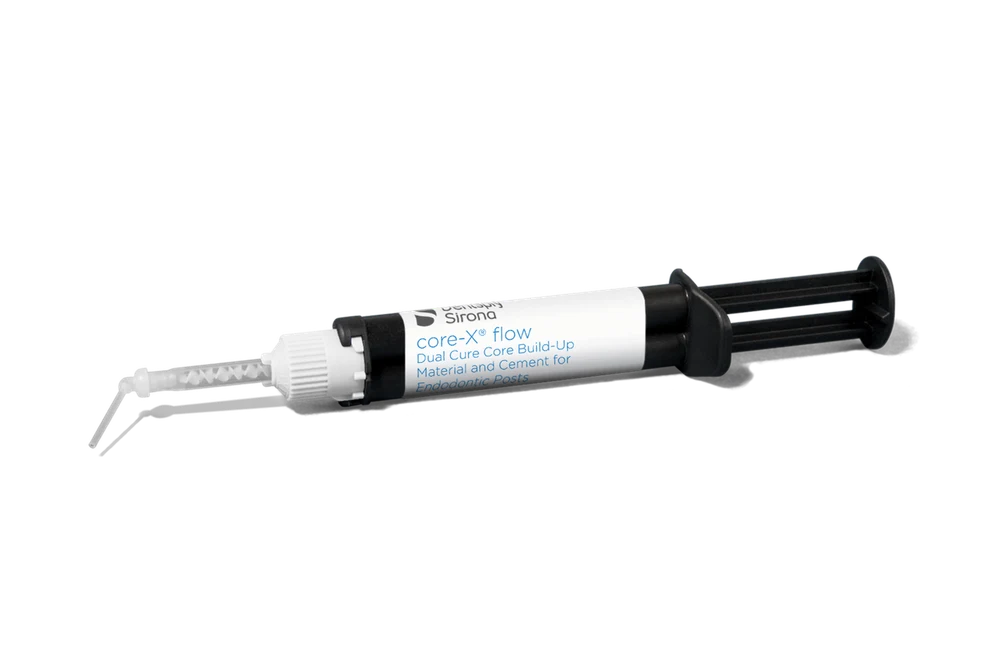
Dentsply Sirona core-X flow is a dual-cured composite resin core build-up and post-cementation material, supplied as a base and catalyst that form the named system when mixed, typically in a dual-barrelled automix syringe. That identity supports a specific approved order. It does not establish compatibility with every adhesive, post or application tip in the clinic.
A product carrying both post-cementation and core build-up roles still has its own companion requirements. Confirm the approved adhesive, any activator, automix tip and application accessory through the exact product instructions. Record what the starter kit includes and what must be replenished separately. A refill syringe without its approved consumables is an incomplete preparation object.
Cure mode and adhesive activation are compatibility fields
Light-cured, self-cured and dual-cured descriptions should remain explicit in the material register. They do not all impose the same compatibility requirements on an adhesive. The clinical reviewer needs the actual cement and adhesive instructions for the proposed combination. Purchasing should collect those documents instead of assuming a universal adhesive automatically covers every curing arrangement.
G-Premio BOND, for example, has a separate Dual Cure Activator product in its commercial range. The existence of that item is a reminder to check the named combination and its conditions — not an instruction to add it to every purchase. The approved material set should state whether an activator is required and exactly which one.
Avoid carrying timing, surface-treatment or post-length rules into the purchasing table. Those are professional operating questions tied to exact materials and clinical circumstances. The buyer’s acceptance criteria should focus on approved identity, complete companion supplies, packaging and current documents. An order can be precise without inventing a clinical protocol.
Procurement object table
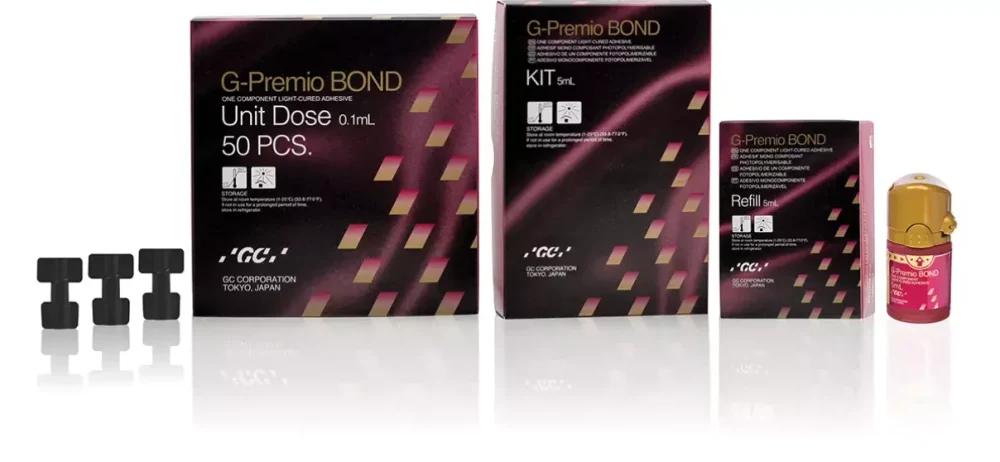
GC G-Premio BOND packaging and bottle.
| Purchase object | Exact order fields | Dependency to confirm | Receipt evidence |
|---|---|---|---|
| Class V restorative composite | Clinician-approved full product, shade, variant and format | Correct dispenser or tips | Name, variant, lot and expiry |
| Flowable refill | Full family and generation; F00 or F03 where approved | Product-specific instructions and tips | Variant retained on sealed label |
| Adhesive | Approved product and bottle or unit-dose format | Compatible restorative or cement combination | Product and companion labels |
| Fibre post | Manufacturer, system, post reference and dimensions | Matching drill and cement review | Reference and size matched to approved entry |
| Post drill | Exact post-system drill reference | Approved post relationship | Drill identity and instructions |
| Post cement or core material | Approved product, cure mode and delivery format | Adhesive, activator and application supplies | Complete named material system |
| Finishing supplies | Approved discs, strips, polishers and paste | Matching mandrels and material documentation | Refill identities and accessory completeness |
Fill the restorative and post rows from their separate approved lists. A shared stockroom should never merge their commercial identities. The clinic can then see what is available, what is running low and what needs clinical review before substitution.
Mistakes in shared adhesive inventory
A common mistake is calling every resin material “composite” on the order. That wording erases the distinction between direct restorative, cement and core products. Use complete names in the purchasing system and keep the approved application list accessible. The receiving assistant should not have to infer a material’s role from packaging shape.
Another mistake is accepting a replacement adhesive without reviewing its relationship to the existing post cement. A bottle change can affect the approved system and its companion supplies. Put the original and the proposed replacement into a written comparison with their actual instructions. The responsible clinician approves the combination before the new item becomes routine stock.
Finally, avoid copying uncertain chemical names or filler comparisons into a commercial specification. Exact named products and their current documents are more useful than an unsupported percentage. If the clinical team requests a material property as a purchasing criterion, obtain it for the specific product and preserve its measurement context. Do not reconstruct it from a broad category label.
Maintain separate direct-restorative and post-material registers
For the Class V stock list, record the clinician-approved paste composite, flowable product and adhesive as separate identities. Include each product’s shade and presentation. A cervical shade name is a product field, not an instruction to apply a material in a particular layer. If a supplier changes a viscosity or product suffix while retaining the brand, show the change explicitly before the quote is approved.
The post-material register should identify the named post system and the preparation instruments belonging to it. Retain the manufacturer’s own size map instead of ordering an unqualified “large fibre post.” A post, its drill and the cement are different objects. An assortment that includes posts does not establish that the clinic already holds the matching preparation instrument or the requested cement dispensing accessory.
For core-X flow, distinguish the dual-cured material from the posts and from the adhesive. The product’s stated core-building and post-cementation roles do not create compatibility with every post or adhesive. Ask for the actual approved combination and its product documents. Preserve any required activator as a separate named item, so its presence can be checked without inferring it from the adhesive bottle.
Inspect the delivery through the two material lists
Match direct restorative syringes and unit doses by product, shade and format. Count dispensing tips separately if they were ordered as refills. For a Shofu Flow Plus or Flow Plus X entry, preserve the full product suffix and flow designation. A familiar syringe shape or colour code should not erase the difference between the requested material and the offered replacement.
On the post side, reconcile sealed post packs to the approved system’s size map. Check the preparation instrument reference independently. Record the cement’s base-and-catalyst presentation and the supplied mixing and application accessories. A dual-cured cartridge is an incomplete replenishment line when the requested compatible dispensing supply has been left out of the order.
Keep the adhesive stock record connected to both approved material combinations without assuming one approval covers the other. A light-cured direct restorative and a dual-cured post material place different compatibility questions before the reviewer. The purchaser’s useful job is to retain the exact relationship and its document, then flag a changed product, a missing activator or a changed delivery tip before the tray is prepared.
Class V and fibre-post purchase checklist
- Record the paste composite and flowable product as different stock identities.
- Preserve shade, presentation and the complete viscosity designation.
- Identify the post system, its size map and matching preparation instrument.
- Separate post cement, core material and adhesive entries even when a product has multiple stated roles.
- List the required activator by name where the approved combination needs one.
- Reconcile mixing and application accessories to the actual cement presentation.
- Route a changed adhesive-material combination to the responsible reviewer.
Orthentra supports China dental sourcing with a transparent 3% service fee and clinic-operations consulting. A restorative and post sourcing brief can be built directly from the clinic’s two material registers — post sizes, drill references, cement presentation and the documented adhesive relationship included.