8 Questions Your Dental Supplier Must Answer Before You Send a PO
A quotation can look complete while leaving the actual purchase undecided. “NiTi wire,” “self-ligating bracket” and “orthodontic pliers set” are product categories. They leave important fields blank, and your receiving team still needs to know which wire, which bracket family and which instruments belong inside the box.
Resolve those fields before the purchase order goes out. Ask the supplier to answer beside each quoted line, then keep the answer with the approved photograph. A long email thread is a poor substitute for a completed item description.
The eight questions below cover archwires, aligner kits, bracket systems, pliers and bonding materials. They give procurement staff a way to record the product the clinician has selected. Clinical selection stays with the clinician; purchasing checks make sure that selection survives quotation, dispatch and receipt.
1. What is the full product identity?
Ask for the manufacturer, product family, complete reference and selected variant. Keep the suffix. A family name and a reference serve different purposes: the family helps you search; the complete reference identifies the quoted item.
TMA is Ormco’s brand name for beta titanium. That distinction belongs on a wire order: a request for a specific branded TMA product and a request for another beta-titanium wire are separate requests. Write down which one the clinician approved before comparing quotations.
Bracket names need the same care. Mini Twin, Mini Diamond and Orthos are separate product families. “Metal bracket” does not distinguish them, and neither does a claim that a bracket is “the newest generation.” Ask for the named family and exact variant, then preserve the approved prescription and tooth-position fields without choosing those settings yourself.
An acceptable answer is a completed product line, not “same as your previous order.” If the previous reference has changed, ask the supplier to list the old and new references together. Catalogue editions change; confirm the current reference before ordering.
2. Which dimensions and shape are being supplied?
An archwire size needs its unit and cross-section. A round wire marked .014 carries a single diameter value. A rectangular wire marked .014 x .025 carries two separate dimensions. Those inch-based descriptions identify different products even though they share the first number.
Put the full marking into the PO. Keep the decimal point and a clear “x.” Never reduce a rectangular description to “014 wire.” Record archform and jaw designation separately when the selected product specifies them.
Material, shape and thermal descriptors belong in different columns too. Reverse curve describes a wire shape. Nickel-titanium identifies a material family. Heat-activated is a product descriptor. Ask the supplier to preserve every descriptor in the approved line rather than collapsing the whole description into “NiTi.”
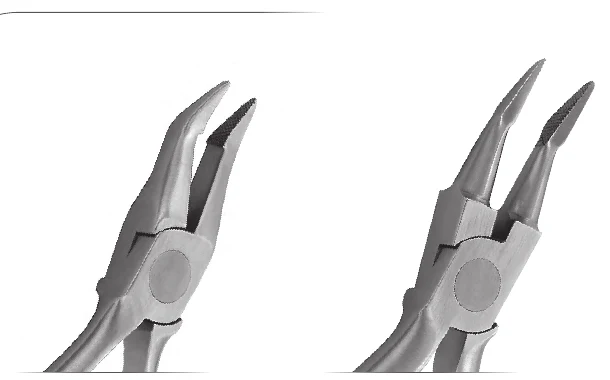
For pliers, ask where the extension sits. Reference 04-302-04C identifies a long-handle distal cutter, while 11401PL1150319 identifies a long-neck distal cutter. “Long type” loses that distinction. Require a full side photograph showing the handle, neck and head.
3. Which working feature distinguishes this variant?
Ask the supplier to name the feature that makes the selected variant different. This is the answer your receiving staff will check against a close-up photograph.
For a cutter, separate the cutting pattern from the holding feature. Reference 04-302-04E is a flush cutter with hold; reference 11401PLDEN002 specifies a without-hold variant. Do not accept an answer that says only “distal cutter.” Put “with hold” or “without hold” into the item description.
For a utility plier, identify the head profile. The straight How reference 04-301-04 and the angled How reference 11401PL1150430 share a listed length of 12.5 cm — length alone cannot tell them apart. Ask for the side view, then match reference and profile together.
For brackets, separate material from ligation mechanism and named system. A ceramic description answers a material question; a self-ligating description answers a mechanism question. Keep each selected field in the order, and never let a salesperson’s broad category replace the complete product description.
4. What exactly is included in each pack or set?
Ask for the selling unit and a contents list. Record the number of packs ordered separately from the number of instruments or components expected. The word “kit” supplies none of that.
Reference 11401PL1150905 is a male/female torquing pair with two instruments per set. The order should say so explicitly. When the parcel arrives, count the named instruments inside the set rather than recording that a box arrived.
For bonding materials, distinguish a starter kit from a refill. Write down the adhesive, primer or sealant, delivery format and listed accessories. A syringe refill and a kit containing other components need separate purchase descriptions.
5. Can you send photographs of the exact item and label?
Ask for the package label, the full item and the identifying detail. Choose the detail to match the question: an open cutter head, the side profile of an angled plier, a bracket’s selected variant, or the contents of a paired set.
Keep each photograph attached to its purchase line. A generic product-family picture does not answer which reference is being dispatched. Ask the supplier to confirm the photograph matches the quoted variant, and mark any example photograph as an example so it cannot become an accidental acceptance image.
Separate outer packaging from inner contents. For an aligner order, organise receiving records around the order identifier and the bag markings supplied with the shipment. Photograph only the details needed for the purchasing check, and keep identifiable patient labels out of any image that leaves the clinic.
For instruments, include visible pads, rods and accessories in the photograph request. The band-removing reference 04-301-02B has a pictured contact pad; the adhesive-removing reference 04-301-10A specifies a T/C rod. Those are distinct things to check at receipt. Keep “T/C” as the specified marker until the supplier confirms the insert specification.
6. Which documents belong to this exact product?
Ask for the applicable instructions, specification sheet and any compatibility statement the order needs. Match the reference on the document to the reference on the quotation, then file the document with that purchase line.
For a cutter, obtain the permitted wire materials and sizes for the exact instrument. Never copy another brand’s cutting limit into your purchase sheet. For reusable instruments, obtain the manufacturer’s reprocessing instructions for the supplied model.
For a light-cure bonding system, obtain the material instructions and the requirements for the clinic’s curing equipment. A curing time belongs to the exact material and lamp specifications. Leave clinical operating instructions to the responsible clinician; procurement needs the correct documents and named components.
Colour nicknames also need translating into formal product names before ordering. An adhesive, a primer or sealant, and a band cement are different purchase lines. Ask which component the quoted reference supplies and which companion components the selected system requires. The clinician approves any proposed change to the system.
7. What are the dispatch commitments for this order?
Separate a quoted lead time from a confirmed dispatch commitment. Ask what triggers the clock, which items are ready, which are awaiting confirmation and whether the supplier proposes a split shipment. Put the answers into the order record.
For custom products, record the approval or data-submission event that starts production. Never copy a historical promotional turnaround into the PO. Require the supplier to state the commitment for the actual order, with any conditions written beside it.
For stocked products, ask the supplier to confirm the ordered references before dispatch. If an item changes, update the line and obtain approval before it leaves the warehouse. Keep the original selection and the approved replacement visible in the record.
Request a dispatch list in the same line order as your PO. Staff can then match references and quantities without rebuilding the supplier’s naming system while unpacking. Add your own internal item code if it helps route stock to the correct cupboard.
8. How will a mismatch be documented and resolved?
Agree the contact, the evidence required and the next step for wrong references, missing components or visible damage. Ask for that process before paying, then give the receiving team the same instructions.
Use photographs of the label and the disputed feature. Record the PO line, the expected item and the received item together. Keep the affected packaging with the instrument or material while the supplier reviews the discrepancy.
Agree written approval for substitutions. “Equivalent” needs a named replacement and a reviewable specification. The person responsible for product selection approves the replacement before the purchasing record changes.
Your receiving form should capture a decision. A parcel marked “received” still needs its contents checked against the approved order. Record acceptance, or hold the affected line for clarification, with the reason and the responsible person’s name.
Copy this supplier-answer sheet
| PO field | Supplier answer required | Clinic acceptance record |
|---|---|---|
| Product identity | Manufacturer, family, full reference and suffix | Approved line and current reference |
| Dimensions and geometry | Unit, cross-section, archform, jaw or head profile | Exact selected fields retained |
| Variant feature | Holding feature, ligation mechanism, insert or accessory | Matching close-up photograph |
| Pack contents | Selling unit and named components per pack | Packs and contents counted separately |
| Photographs | Label, full item and identifying detail | Images attached to the correct line |
| Documents | Exact-product specifications and applicable instructions | References matched and files stored |
| Dispatch | Order-specific commitment, trigger and split-shipment plan | Written commitment filed |
| Discrepancy process | Contact, required evidence and proposed remedy process | Named receiving contact and decision |
Common mistakes before approval
Do not let the quotation shorten your original request. A dropped suffix, a missing wire dimension or a deleted with-hold field changes what the receiving team can verify. Compare the supplier’s returned description with the selected description, line by line.
Keep optional contents visible. A paired instrument set, an aligner accessory and a bonding-system refill each follow different counting rules. Write the rule before the parcel arrives.
Keep prices beside completed descriptions. Comparing an incomplete item with a fully specified one produces a misleading purchasing comparison. Resolve identity, contents and dispatch terms first.
Final PO checklist
- Obtain an answer to every field on the supplier-answer sheet.
- Preserve full references, suffixes, units and selected variants.
- Attach the approved product and label photographs.
- List kit contents and optional items explicitly.
- Match specifications and instructions to the exact supplied product.
- Obtain approval for every substitution before dispatch.
- File order-specific dispatch commitments and discrepancy contacts.
- Give the receiving team the completed expected-item record.
Orthentra provides China dental sourcing at a transparent 3% fee. We turn your selected products into a clear purchase sheet, collect supplier answers and organise receiving records — so your team gets an order it can check, from the quoted reference to the contents of the delivered pack.
Want someone to check a Chinese supplier for you? See Supplier Check.